
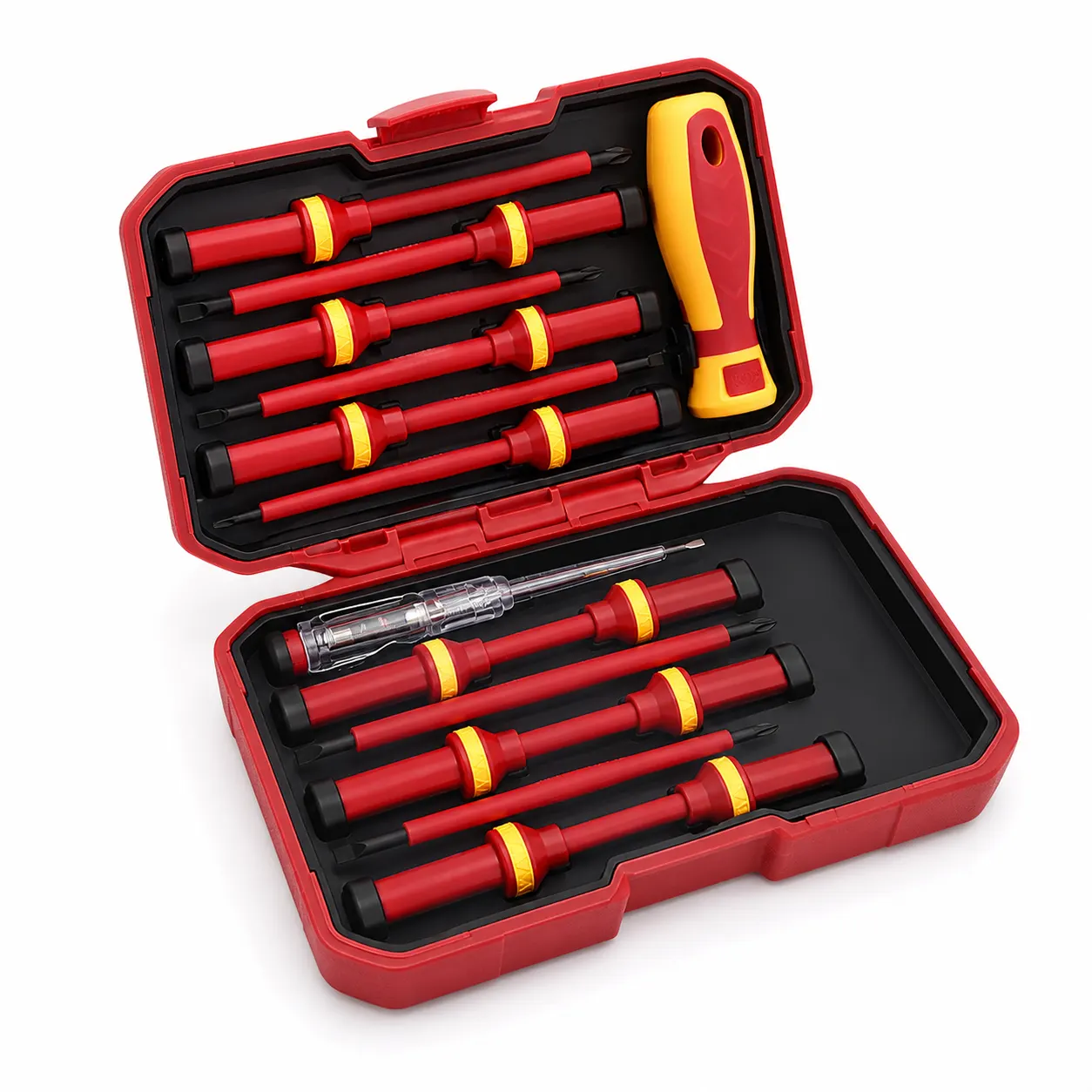
Short answer: An insulated screwdriver set for a small business should fit a defined bench task and the company's electrical-safety procedure. The listed 13-piece set has insulated construction, an insulated-rubber handle and chromium-vanadium steel blades and shafts. The page does not state the driver profiles, sizes, voltage rating, VDE or IEC compliance, certification or suitability for live work. Manufacturer does not specify those points. HSE guidance places planning, isolation, suitable equipment and competence ahead of tool convenience, so a business should verify the set's documents before adding it to shared equipment.
Define the business use
Write down the recurring tasks at the packing bench, maintenance cupboard or repair table. General assembly, covers and fixtures may require several ordinary screwdriver sizes, while specialist electrical or precision work may require documented profiles, ratings or torque control. The 13-piece label cannot distinguish those needs.
The current page identifies chromium-vanadium steel blades and shafts and an insulated-rubber handle. It does not publish a complete contents list, shaft dimensions, torque limits or storage arrangement. Manufacturer does not specify whether the selected set covers the fasteners your business sees.
| Business control | Why it matters | Listing status |
|---|---|---|
| Contents register | Confirms the correct driver is available | Exact profiles and sizes not stated |
| Electrical evidence | Supports the task risk assessment | Rating, standards and certification not stated |
| Condition check | Finds damaged insulation or tips | Inspection interval not stated |
| Storage owner | Keeps a shared set complete | Storage system not stated |
Keep electrical controls separate
HSE says electrical equipment work should be planned and energy sources isolated, with isolation secured against inadvertent reconnection. Staff must be competent for the work or supervised by someone who is. Buying a set described as insulated does not lower those requirements.
The product page does not provide a voltage rating, standard, certificate or live-work statement. Manufacturer does not specify them. A small business that needs traceable insulated tools for controlled electrical work should obtain those documents or select a product that publishes them.
Set one shared-tool routine
A simple routine is enough for a small team. It should identify the task, confirm isolation and competence where electrical equipment is involved, select the correct driver and return the tool in inspectable condition. This reduces improvisation without pretending the set has unlisted protection.
- Assign the set to defined tasks and record the required driver profiles and sizes.
- Confirm isolation and the responsible person's approval before electrical equipment work.
- Inspect handles, insulation, shafts and tips before issue, removing damaged tools.
- Return every piece to the same controlled location and investigate any missing item.
Purchase and documentation limits
Manufacturer does not specify exact contents, voltage rating, VDE or IEC compliance, conformity, independent certification, live-work suitability, environmental resistance, inspection interval or service life. Do not infer any of these from the product name, handle colour or gallery.
At £29.61 with VAT included, the set may be a reasonable general hand-tool purchase when the contents are confirmed. Free UK Delivery and 30-day returns may simplify procurement, but a business safety file still needs the actual product documentation required by its risk assessment.
Related guides and product details
Buy for a small business only when the exact contents and electrical evidence match the controlled tasks assigned to the set. Read Insulated Screwdriver Set UK: Evidence to Check for related guidance. Read How to Choose an Insulated Screwdriver Set for related guidance. Review the documented specification on the 13-Piece Insulated Screwdriver Set product page before ordering.
Sources and safety context
- Supports the documented construction, materials, count, price and missing specification fields. Current Screwdriversets product page.
- Supports planning, isolation and competence controls for electrical work. HSE: Work on electrical equipment, machinery or installations.
- Supports suitable equipment, maintenance and competence considerations. HSE: Electrical safety frequently asked questions.